
When choosing sales reps for your business, the first key decision is whether to go down the route of inside or outside sales. This article gives key points to help you understand the difference between the two, and begin to decide which is the best for your business.
Defining The Roles
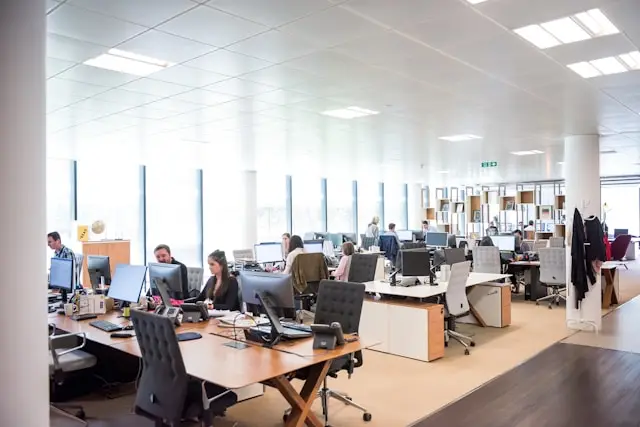
Inside sales reps work remotely from their clients, selling products or services over the phone or by using email or other online communication channels. Typically, they will work alongside an inside sales team in a shared office space (though increasingly now they may work from home, too) in contrast to outside sales reps who will work face-to-face with their clients.
There are two divisions of inside sales reps:
- Sales development reps, who follow-up warm leads from potential clients who have, for example, requested a demo via a business’ website. These clients are generally small businesses that the sales development rep will make contact with before passing the details on to an account executive to nurture that client relationship further in order to close a deal.
- Business development reps, who act as cold callers to higher-end commercial clients before also passing successful leads on to account executives.
Outside sales reps work ‘in the field’, building client relations and closing deals by meeting clients in person. They will often travel to meet clients at their business premises, or else forge connections at industry events or even casual gatherings such as business happy hours. Outside sales reps will work in specified territories, with teams to cover large geographical areas.
Inside Sales Reps
The major advantage of hiring inside sales reps is their cost efficiency. With technological advances such as CRM (Customer Relationship Management) systems and social analytics software, reps can decide which are the right business prospects to contact, faster than ever before. The sales cycle is shortened and the cost per acquisition is reduced.
A further two advantages come from inside sales reps being based in an office environment. Firstly, due to them not having to travel between clients, they have more time to complete their sales-based administrative tasks. Additionally, they will have more opportunities for collaboration and coaching due to their close proximity to managers and more experienced colleagues.
It can be easily argued that inside sales aligns more closely with the increasingly digital world that we live in. Online campaigns and calls to action are more appealing to many clients than face-to-face meetings, not to mention they allow for greater flexibility in already time-poor schedules.
However, the limited personal interactions between inside sales reps and their clients may present a challenge for client relations, which rely heavily on trust and rapport. Both of these are often easier to build with face-to-face contact.
Reduced face-to-face contact may also make it harder for reps to stand out from their competitors, as more companies move to an inside sales model.
Outside Sales Reps
Outside sales reps use face-to-face client interactions to foster the trust and connections required for sales and increased business. This helps clients to build a positive image of a company faster, as well as their trust in a product being bolstered by the live demonstrations and try-outs that outside sales reps can facilitate.
A major advantage for the reps themselves is the flexibility that this role can provide, in contrast to a tightly timetabled office role. Reps can often set their own schedule (to fit with their clients’, obviously) and the appeal of not being confined to an office is strong for many reps.
This self-management is not everyone’s cup of tea, however. It requires management to be more flexible too, and loosen control on employees. Some reps would rather work in an office to avoid the irregular hours that can come with aligning schedules to fit neatly with a client’s prior engagements, and the lengthy travel times that are commonplace for outside sales reps.
Business Model and Target Audience
Your business model may lean more towards inside or outside sales, and it is important to work out which is the best fit for you.
For example, a business with high online engagement and reps with excellent virtual communication skills will often succeed in making deals through phone and email. A younger target audience will tend to expect a level of virtual engagement with a company, whereas an older target audience may have more traditional expectations of reps travelling to meet them.
Cost & Budget Considerations
Both inside and outside sales models have cost implications to consider, and it is vital for you to strike the right balance for your business.
In a business dependent on inside sales, there will be a large investment in the right software to collate and manage needs, for example advanced CRM databases and smooth web conferencing tools to allow seamless remote communication.
But after this outlay, inside sales can save a business considerable amounts of money: the Harvard Business Review suggests that inside sales can reduce the cost of sales by between 40 and 90% when they are managed most efficiently (source).
Outside sales have a primary cost of travel expenses for the reps who may be on the road daily to meet different clients. This may also extend to lodging costs for long-distance trips.
Typically, the salary for outside sales reps was higher than their counterparts in inside sales due to their travel commitments and the increased level of responsibility of working alone. The payoff is, of course, the possibility of stronger client bonds and therefore better deals being struck.
Sales Cycle Length
The sales cycle is the process by which reps identify leads, establish contact with clients, sell the product, close the deal and then follow up with clients afterwards. The length of the cycle can be influenced by many factors, for example the product itself, the target market and the ‘newness’ of the product.
A newer product may require more explanation for a client, and therefore more persuasion may be needed to close the deal. Traditionally it would be the task of an outside sales rep to present and demonstrate the new product but, in the digital age, this is changing and more businesses are able to use inside sales for the sales of new products.
Similarly, a client who is new to a business may need more interaction to build trust with a rep in order to close a deal. Previously this would be been the job of an outside sales rep, but dependent on the target market demographic, this may also be undertaken by an inside sales rep, especially with improvements to web conferencing software to allow smoother communication between reps and clients.
Understanding your sales cycle is vital for business managers, in order to project the trajectory of a business and allocate resources effectively. This understanding is also key to deciding which sales model is most appropriate to the business.
Conclusion
Traditionally, inside sales were perceived as second-rate to outside sales, which was higher paid and better thought of. But the growth of the online world, especially post-pandemic, had shifted this balance dramatically.
Businesses must evaluate their unique needs and circumstances carefully when choosing to pursue either inside or outside sales. HyperHired can help you to hire the right reps to help your business succeed, whichever route you choose.